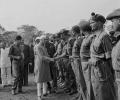
The conversations on July 22 and 23, 1962, meetings in Geneva between V K Krishna Menon, India's defence minister at the time, and Chinese vice premier Chen Yi are important because, had they been followed up, the subsequent border war may perhaps have been avoided, notes former foreign secretary Shyam Saran.

'We are open to all countries around the world as long as we get a fair deal, as long as we are ensured continuity in the engagement.'

China's national observatory issued a red alert -- the highest level in the country's typhoon warning system -- as Typhoon Dolphin hit Zhejiang province on the eastern coast on Sunday afternoon.

A 7.0 magnitude earthquake struck China's Tibet Autonomous Region on Thursday, according to the China Earthquake Networks Centre. The quake, which hit Baqen County, occurred at a depth of 10 km. There were no immediate reports of casualties or damage. The Tibetan Plateau is known for its seismic activity due to the collision of the Eurasian and Indian tectonic plates.

Former US National Security Adviser John Bolton has stated that China is not prepared to back India's bid for a permanent seat on the UN Security Council. He highlighted that any expansion of permanent membership would require a UN Charter amendment, which China could veto. Bolton also discussed the broader institutional challenges facing the UN and suggested that regime change in Iran is crucial for long-term stability in West Asia, linking Houthi attacks to Iran's "ring of fire" strategy.

China on Wednesday reacted strongly to the Quad Ministerial meeting that voiced serious concerns over the situation in the East and South China Sea, saying they should stop meddling in maritime affairs in its neighbourhood.

Anthony Andrews, the highly successful coach of East Bengal FC, has been appointed as the assistant coach for the India Under-17 women's national team. He joins the team in Tashkent for friendly matches ahead of the AFC U17 Women's Asian Cup Qualifiers, bringing his extensive experience and winning record, including four IWL titles and continental success with East Bengal.

India has accumulated experience organically and in public, through blood, sweat and toil -- one commissioning and one agreement at a time -- and is called a regional power. China has accumulated hulls, by misdirecting its industrial capacity, and is mistakenly called a superpower. The Indo-Japan defence agreement pushes this theory to its limits without ever naming the dragon in the room, points out Dr Abhishek Puri.

Deepadhar, featuring former Asian Games gold medallists, has taken an early lead in the fifth East Zone Bridge Championship in Kolkata, accumulating 65.22 Victory Points after four rounds. The tournament, a Bridge Federation of India Ranking Two event, involves around 300 players from 50 teams across East Zone states competing for a Rs 6 lakh prize purse, with the top 16 teams advancing to the knockout stage.

Sagnik Roy and Sayantan Kushari, fresh from their gold medal win at the World Youth Transnational Championships, will lead a strong field at the fifth East Zone Open Bridge Championship in Kolkata. The three-day event, organised by the West Bengal Bridge Association, features a Rs 6 lakh prize fund and will host top bridge players from the Eastern Zone and beyond.

India and China are in what experts call 'a cooperation-versus-competition situation'.

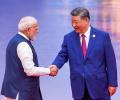
During the 18th BRICS Summit in New Delhi, Chinese President Xi Jinping and Prime Minister Narendra Modi held a bilateral meeting, outlining a four-point approach for the steady and long-term development of China-India relations. The leaders stressed strategic understanding, win-win cooperation, mutual respect, and inclusive multilateral engagement, reaffirming their commitment to resolving the boundary question and addressing economic concerns. They also discussed global challenges and strengthening people-to-people ties.

US President Donald Trump has issued a waiver from sanctions under the Sanctioning Russia and Iran Act, citing national interest. This move comes after a deal with Russia for diesel supply and ahead of a US official's visit to India, where concerns about the act's impact on India's oil imports were raised.

'The Chinese military cannot advance much in Ladakh, even if they want to.' 'Similarly, in Arunachal Pradesh, they can rename a village or two, intrude here or there, but cannot do much more realistically.'

India and Japan have signed a Memorandum of Arrangement on maritime security cooperation, committing to deepen defence ties and oppose unilateral actions that impede freedom of navigation in the Indo-Pacific, a move seen as directed at China's increasing military presence.

Typhoon Bavi made landfall in eastern China, leading to the evacuation of nearly 2 million people. Authorities issued red alerts for rainstorms and orange alerts for the typhoon, causing widespread cancellations of flights and ferry services, and the closure of tourist attractions.

'The trigger for the flood was definitely natural, but the damage that it caused was human-made.'

'I know China will implode. It is scientifically impossible for China to control a nation through the barrel of a gun.'

Navigating this geopolitical minefield requires a cold-blooded blend of immediate tactical pleading, structural domestic diversification, and aggressive collective resistance, suggests Ambassador Rajasekhar.

China sailed through the crisis in the Strait of Hormuz relatively unscathed even as the impact of its steps shielded other consuming nations from having to pay high crude oil prices.
The Indian Consul General in Shanghai inaugurated the annual East China Indian Diaspora Cricket Tournament and a curtain-raiser event for the International Day of Yoga (IDY) 2026, highlighting the community's strong cultural presence and global outreach.

India is deeply concerned by the growing consolidation of Pakistan-backed jihadi and radical Islamist groups in Bangladesh, particularly in the strategically vital Chittagong Hill Tracts, which experts warn is transforming the country into a new safe haven for these networks and posing a direct threat to India's security.
India and China held diplomatic talks to review the situation along the Line of Actual Control (LAC), discussing boundary delimitation, border management, and trans-border cooperation. Both nations stressed the importance of maintaining peace and tranquillity for bilateral relations and agreed to continue using existing channels to resolve outstanding issues.

Former Indian shooter Rajeshwari Kumari has been appointed as the South Asia representative to the Olympic Council of Asia's (OCA) Athletes Committee. Her nomination was approved by the OCA Executive Board, bypassing elections held for other zonal positions. This appointment highlights her continued involvement in sports administration following a successful shooting career and her family's legacy in Olympic sports.

'India should not trade away its energy security for temporary tariff relief. Neither signing a trade agreement nor stopping Russian oil purchases can protect it from future US action.'

Saudi Arabia's East-West pipeline shutdown could make crude costlier for India as refiners face fewer supply routes and rising freight and insurance costs.

The objective should be clear: Energy security without abandoning environmental responsibility; water security without ignoring local concerns; and strategic resilience without sacrificing public confidence, notes Varun Arya.

Indian golfer Pranavi Urs, fresh from winning a maiden Asian Games gold, has set her sights on an Olympic medal and a Major title.

Pranavi Sharath Urs delivered an exceptional 7-under 63 at the Asian Games golf competition, placing her in sole second position individually and elevating the Indian women's team to bronze medal contention. Her performance, marked by clean ball-striking and aggressive play, has created significant momentum for India's medal aspirations in both individual and team events.

Indian golfers Pranavi Urs and Saptak Talwar delivered impressive performances on the opening day of the Asian Games, with Urs lying second in the individual women's standings and Talwar tied third among men. The Indian women's team is tied sixth, while the men's team is tied fifth, setting a promising tone for the competition.

China on Tuesday listed out the four-point proposal given by President Xi Jinping for lasting peace in the Middle East.

Chinese foreign ministry spokesperson Mao Ning said that the country believes that dialogue and negotiation are the only viable solutions to resolving disputes and that the continued escalation of the conflict serves no one's interests.

Anthony Andrews, a highly successful coach in Indian women's football, has been appointed as the assistant coach for the India U17 women's national team. He will continue his dual role with East Bengal FC while preparing the Young Tigresses for the AFC U17 Women's Asian Cup China 2027 Qualifiers.

Volkswagen, a long-standing but minor player in India's fiercely competitive automotive sector, is now exploring a strategic partnership with the JSW group, aiming to revitalise its market presence, enhance profitability, and potentially establish India as a key export hub for electric vehicles.

Japan is deepening its defence relationship with India while simultaneously expanding its economic, infrastructure and security engagement with countries around India -- particularly Bangladesh. The result is an emerging Japanese conception of South Asia in which India remains the strategic anchor, but the geography surrounding India is becoming increasingly important, points out Varun Arya.

President Donald Trump is hosting a lavish state dinner for Chinese President Xi Jinping at the White House. The event, meticulously prepared by First Lady Melania Trump, features a unique blend of American and Chinese culinary traditions, a historic toast, and a star-studded guest list including top tech and business leaders. The evening will also include musical performances and decor reflecting Chinese cultural significance.
India's dual pursuit of a robust strategic partnership with Washington and a pragmatic, tension-management policy with Beijing represents the essence of modern multi-alignment. By embracing economic pragmatism, learning to compartmentalize political differences, and engaging in continuous dialogue, India can secure its borders, grow its economy, and contribute to a stable, multipolar Asian century, points out Ambassador Rajasekhar.
Ahead of Xi Jinping's visit, National Security Advisor Ajit Doval and Chinese Foreign Minister Wang Yi held extensive talks in Beijing on August 25 on the boundary issue and reached an eight-point consensus.

A Kishore Kumar song, a birthday cake, a prince's break from protocol to thank his driver, a Persian painting on the ceiling of the presidential residence -- the BRICS Summit had many memorable moments.

Gwadar is viewed as a critical pearl in China's maritime strategy as it would give a permanent logistical footprint near an important choke point - the Strait of Hormuz and the oil rich Persian Gulf, explains Commodore Venugopal Menon (retd).
